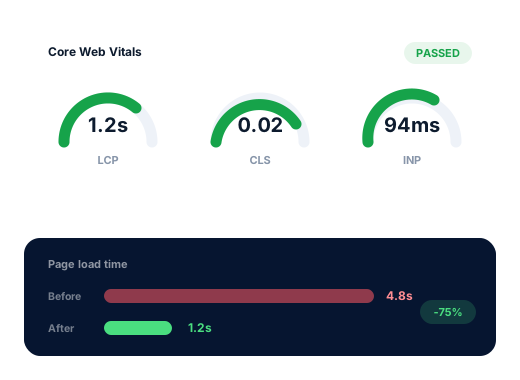
Largest Contentful Paint (LCP)
LoadingWhen the biggest item on screen, usually a photo or a headline, has finished appearing. The target is 2.5 seconds or less. Oversized images and a sluggish server are the usual reasons for a poor result.

Speed Optimization
Quicker loading for Thunder Bay business websites, measured the way people actually reach them: on phones over mobile data, frequently from a parking lot, waiting room or hotel lobby.

On the office computer in Thunder Bay, Ontario, your website probably feels quick. Customers meet it differently: for the first time, on a phone, on mobile data, in a hurry. Someone just off a flight at the airport, a relative sitting in a hospital waiting room, a homeowner standing in a cold basement beside a furnace that will not start. On those visits a page that seemed instant at the desk can take several times as long.
Many of those searches are urgent. Google’s suggestions include “emergency dentist thunder bay open now”, “thunder bay hotels for tonight” and “thunder bay walk in clinics open now”. People making choices like these open two or three results and keep whichever one shows them what they need first. A slow page is often closed before it has finished loading.
Speed matters to Google as well. Its ranking systems draw on loading figures collected from real Chrome visits, so a lighter site helps both with the people who arrive and with how often you are shown. The goal is not a perfect lab score; it is a site that passes on real phones in real conditions.
Search demand
There are no Thunder Bay suggestions about site speed itself. These Google.ca suggestions from October 2026 come from people in a hurry, and in each case the page that loads first has the edge.
Not every page deserves equal attention. On most Thunder Bay sites the visits that count are the urgent ones: hours checked during a storm, a menu opened at the end of a shift, an emergency service page loaded in a chilly basement. We find those pages in your analytics and speed them up first, and we aim for a pass in Google’s real-visitor data rather than a flawless lab number.
Usual causes
Most slow sites have two or three of these at once.
A picture straight off a modern phone can be several megabytes, then get squeezed into a box a few hundred pixels wide. Scaling it to size and converting it to WebP sheds most of that.
Common on restaurant, trade and clinic sites. The phone has to download the whole file before anything is readable, and the text locked inside does little for search. A simple web page loads faster and can be found.
Drag-and-drop builders send a large bundle of code with every page, whether or not that page uses any of it.
Pop-up offers, live chat, social media feeds, a handful of tracking tags, an embedded map: each makes extra requests, and most were added years ago by someone who has since forgotten them.
If the server needs a second or more to start answering, nothing further down the page can win that time back. Caching helps, but sometimes the host itself is the limit.
Google’s measures
Chrome gathers these numbers from genuine visits, and Google pools a rolling four weeks of them. A page passes once 75 percent of those visits clear every one of the three bars.
When the biggest item on screen, usually a photo or a headline, has finished appearing. The target is 2.5 seconds or less. Oversized images and a sluggish server are the usual reasons for a poor result.
The pause between tapping something and seeing the page answer. Google wants 200 milliseconds or less. Live chat, image carousels and piles of analytics tags are frequent offenders.
How far things slide around as the page fills in, the reason people hit the wrong link when they meant to tap Call. A score under 0.1 comes from reserving room in advance for photos, banners and late-loading pieces.
The work
Field and lab figures for your key pages recorded before anything is touched, so the improvement can be shown rather than simply claimed.
Every image cut to the dimensions it actually occupies, compressed, delivered as WebP where browsers accept it, and held back until a visitor scrolls close.
Menus, schedules and price lists turned into lightweight HTML that opens faster on phones and that search engines can read.
Dead plugins stripped out, chat widgets and tracking held back until the page content is in, and fonts hosted locally on your site.
Caching at page and browser level tuned to your server, cutting the wait further for repeat visitors.
Lab tests repeated once the changes are live, and real-visitor data reviewed about a month later, when Google has a fresh 28 days to report.
Done carefully
Standards we apply to every account, set out here so you can check us against them.
A quick page with little to say still loses. And nobody needs a score of 100 to rank.
Speed is one input among many in Google’s systems. Where it reliably pays is in visitors who stay instead of backing out. When your site is quick enough, we say so and suggest a better use of the budget, perhaps new service pages or work on your Business Profile. A speed project is quoted once after an audit; holding on to the gains later falls under routine upkeep.
Ask us about your business
How we work
From a first look at your listing to a short monthly report you can read over coffee.
We study your site and Business Profile, then test where you surface from several corners of Thunder Bay.
Together we settle on the searches that matter and tie each to one page or one listing change.
Profile, site, content and directory fixes, beginning with whatever should shift results soonest.
Each month you see the calls, messages and positions we tracked, plus what we will tackle next.
Questions
Enter your address in PageSpeed Insights and pick the mobile results. Read the real-visitor section first; if there is not enough data, treat the lab figures underneath as a rough guide. Then open the site on your own phone with wifi switched off.
On a phone, the main content should appear in 2.5 seconds or less, a tap should get a visible response within 200 milliseconds, and the layout should stay put while loading.
Between two otherwise similar businesses, speed can tip the order. Its steadier payoff, though, is that visitors wait around long enough to phone, book or come in.
Often. On a phone a PDF is slow to load and a chore to read, pinching and zooming the whole way, and the words inside carry little weight in search. Rebuilt as an ordinary web page, it loads faster and can be found.
A small site normally takes a week or two of work. Google’s real-visitor figures cover a rolling 28 days, so the pass usually shows in its reports roughly a month after the changes land.
It is a one-time price in CAD, set after an audit, because no two slow sites share the same cause. Once it is fast, keeping it that way is covered by ongoing care in each of the monthly plans at $300, $500 or $700.
Further reading
More on this topic, written for business owners in Thunder Bay.
Any of these can be taken on its own; many clients begin with just one.
Every trade is searched in its own way here, so every page is researched separately.
Ask for a free audit: where you show up on the north side and the south side, who sits ahead of you, and which fixes to make first.
Ask for my free audit